In communications and marketing, it’s easy to fall into the trap of being busy. Busy creating content. Busy writing newsletters. Busy posting on social media. Busy running ads. Busy attending meetings. Busy reporting on how busy we’ve been.
But busy doesn’t equal effective.
Too often, organisations measure communications and marketing success by the volume or spread of what’s produced, rather than the value it delivers. Page views instead of behavioural change. Media clippings or potential audience reach, rather than stakeholder confidence. Number of social posts instead of trust and credibility. Clicks instead of sentiment or loyalty.
Just this week, we were asked by a potential client how we can measure PR impact beyond reach and awareness. GREAT QUESTION! Every day across sectors, from community organisations, commercial brands, local government, and corporate teams, we see pressure to 'show activity to prove value', which overshadows the real purpose of communications and PR: to create meaningful outcomes that shift understanding, strengthen relationships, and drive decisions or behaviours.
Outputs keep you employed. Outcomes build impact, reputation and influence.
Here are some practical ways to build an outcomes‑first comms culture.
Outputs vs outcomes (and why the distinction matters)
We've seen many strategies and plans over the years, loaded full of 'tactics', i.e., outputs. Outputs are the tangible things you produce.
Think:
Media releases
Editorial/advertorial
Blogs
Podcasts
Social media posts
Reports
FAQs
Invitations
Letters or memos (yep, we still do those)
Community meetings
Videos
Web updates
They’re essential, but they’re not the point.
Outcomes are the changes that result from the communications effort. Outcomes look like:
Increased community trust
A shift in public understanding
Better decisions are made with clear stakeholder insight
Higher participation in a programme or engagement activity
Reduced misinformation
Positive sentiment toward change
Stronger reputation with key audiences
Reviews and referrals
Outcomes are harder to measure, but far more meaningful.
Leaders care about outcomes. Boards care about outcomes. Funders care about outcomes. And increasingly, communities do too. So you should too.
Why comms teams might get stuck in the outputs trap
Most comms teams aren’t intentionally output‑driven; they’ve simply been conditioned that way. Here’s why it happens:
Outputs are easier to count. For example, “We posted 35 times this month” or "We delivered 4 media releases this month" feels like proof of performance… even if nothing changed.
Stakeholders might unintentionally ask for deliverables rather than results. For example, “Can you send out a media release?” is clearer (and faster) than “Help me influence the way our community understands this issue.”
Time pressure encourages task‑ticking. When you’re running at capacity, outcomes feel like a luxury.
Reporting systems focus on activities. If your dashboard tracks volume, your team will chase volume.
Outcomes require deeper thinking, strategic alignment, and often more courage. But, we need to be brave and take the time to measure, evaluate and demonstrate true impact.
An outcomes-first mindset has always been the Belle PR approach
If you want to influence understanding, build a connection or earn trust, you need to start with an outcomes lens. Below are practical ways internal teams can shift your comms, engagement and marcomms practice toward genuine impact.
Start every request with a reframing question
Instead of asking:
“What do you need me to produce?”
Ask:
“What are you trying to achieve?”
Other reframing prompts:
“What change do we want to see as a result of this?”
“Whose behaviour or understanding needs to shift?”
“How will we know we’ve succeeded?”
This moves the focus from tactics to purpose.
Use comms and engagement as problem‑solving disciplines
Communications is often treated as an information and distribution channel. In reality, it’s a behaviour‑change, relationship‑building discipline. Shift from:
“We’ll announce this decision”
to“Let’s identify who’s impacted, what they need and how this affects trust and confidence.”
This elevates comms from service function to strategic leadership.
Start small: build micro‑outcomes into your projects
Not every project needs a giant transformation. Examples of micro‑outcomes:
Improving clarity of information for one key audience
Reducing the number of complaints about a specific issue
Increasing participation in one workshop
Getting stakeholders to a shared understanding
Small shifts build credibility fast.
Report on outcomes, not activities
Move away from:
“We delivered 22 posts and three newsletters.”
Toward:
“Understanding of the project increased by 40% in target audiences.”
“Engagement quality improved, with more informed submissions.”
“Our messaging reduced concerns about X by half.”
If you measure outcomes, leaders will start asking for outcomes.
Use data to shape decisions
Outcomes aren’t “nice to have”; they’re measurable. Useful data sources include:
Engagement sentiment
Click-through behaviour
Attendance and participation patterns
Stakeholder interviews
Pre/post pulse checks
Misinformation tracking
Data creates feedback loops. Feedback loops drive strategy. Strategy drives impact.
The payoff: more trust, more impact, more influence
When you're outcomes‑focused:
You stop chasing content for content’s sake
Your work aligns with organisational priorities
Stakeholders feel heard and understood
Leaders trust your insights
The comms function becomes strategic, not administrative
Not through volume. Through value.
Being busy isn’t the badge of honour we think it is
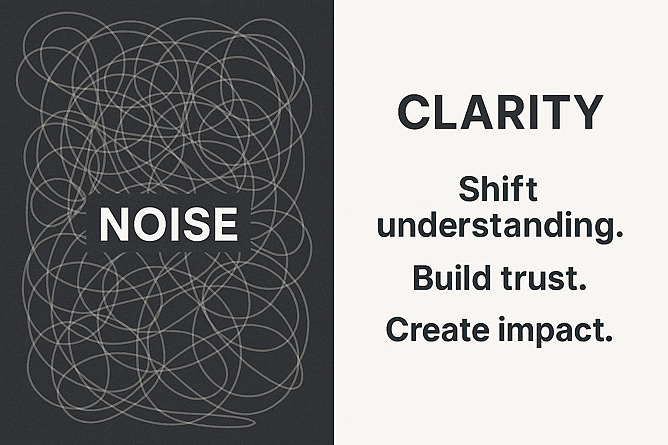
We're living in a world that's flooded with noise. The power lies not in how much you produce, but in what changes because of the work delivered.
Outcomes are the true measure of impact.
Outputs are simply the path that gets you there.